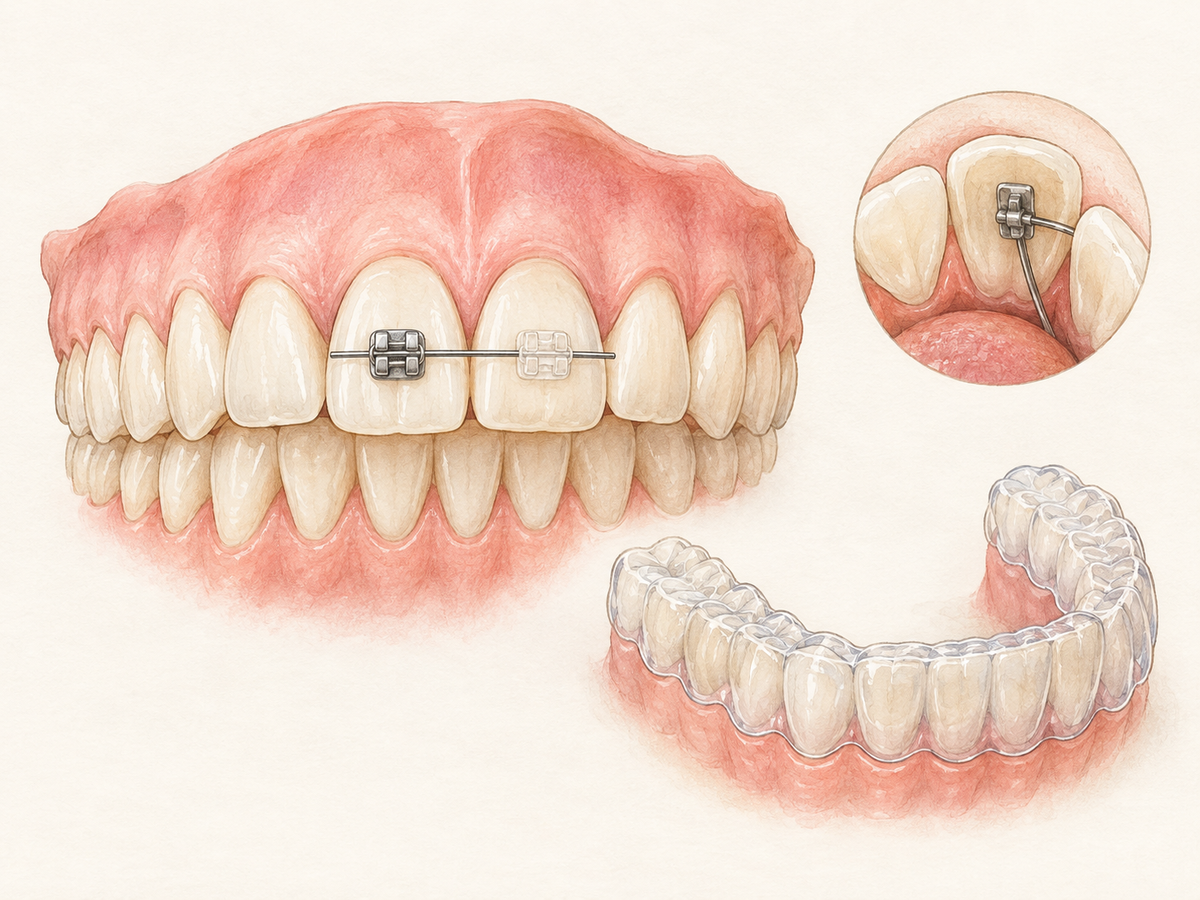
There is no single “best” type of braces for everyone. The right choice depends on how complex your bite is, your budget, how much you mind visible braces, and how reliably you can wear removable trays. Traditional metal braces are still the most dependable option for difficult bite problems. Clear aligners may work well for mild to moderate crowding or spacing, but only if you truly wear them 20–22 hours a day.
The best braces are the ones that can actually correct your bite while fitting your daily habits and budget.
What Changes Between Braces Types
Braces are not just about looks. The main differences involve what they are made of, whether they are removable, how they feel, how easy they are to keep clean, how often you need appointments, and whether they can fix your specific bite problem.
Brackets are the small pieces attached to the front or back of your teeth. A wire runs through them and uses gentle, steady pressure to move teeth. Some braces use tiny elastic ties to hold the wire in place. Removable clear aligners use a series of clear trays to guide tooth movement instead.
Your choice matters because:
- Removable trays are easier to clean around, but only if you wear them as directed.
- Fixed braces stay in place, so they do not depend on your daily habits.
- More visible braces are usually less costly and can handle more complex tooth movements.
- Less visible options may come with tradeoffs like higher cost, speech changes, or more fragile parts.
The Main Types at a Glance
This table gives a quick overview. Exact cost depends heavily on where you live, how long your case takes, and your provider.
| Type | Visibility | Removable | Pros | Cons | Best for | Cost range |
|---|---|---|---|---|---|---|
| Metal braces | Very visible | No | Strong, reliable, often lowest cost | Noticeable; can irritate cheeks at first | Complex bites; any age | Usually lower |
| Ceramic braces | Less visible | No | Blends with teeth; fixed control | Can stain; brackets may break; costs more than metal | Adults or teens who want less visible fixed braces | Moderate |
| Lingual braces | Invisible from front | No | Truly hidden; fixed control | Speech changes, tongue soreness, higher cost, fewer providers | People who need fixed braces but cannot show them | Higher |
| Clear aligners | Nearly invisible | Yes | Removable for eating and cleaning; comfortable | Requires 20–22 hours of wear; lost trays; limited for severe bites | Mild to moderate cases | Moderate to high |
| Self-ligating braces | Similar to metal or ceramic | No | Clips instead of ties; may mean quicker adjustments | No consistent speed or pain advantage; often costs more | Standard fixed cases if offered | Moderate to high |
Metal Braces
Traditional metal braces use stainless steel brackets attached to the front of each tooth. A metal archwire runs through the brackets and applies steady pressure. Small elastic ties, or ligatures, hold the wire in place. Many people like choosing colored bands to personalize them.
Metal braces remain the go-to option for complex or severe bite problems. They are strong, predictable, and usually the most cost-effective fixed choice. When researchers compared clear aligners with fixed braces, fixed appliances often performed better for difficult tooth movements. An umbrella review of aligner and fixed appliance research found that fixed appliances were favored when specific tooth movements were considered.
Modern metal brackets are smaller than older designs, which can ease some comfort concerns. They can still cause cheek or lip irritation early on, but most people adjust within a few weeks.
You should seriously consider metal braces if you have:
- Severely crowded or rotated teeth
- A bite issue that needs major correction
- A complicated case involving extractions or jaw alignment
- A budget where reliability matters more than appearance
Ceramic and Clear Braces
Ceramic braces use tooth-colored or clear brackets instead of metal ones. They still use a visible wire, but the overall look is less obvious than metal braces. These are sometimes called clear braces, but that phrase can be confusing. Ceramic braces are fixed braces, not removable aligners.
Ceramic braces are a middle ground. They give you the control of fixed braces with a less noticeable appearance. Many adults and older teens choose them for that reason.
The tradeoffs are real. Ceramic brackets can stain if you drink a lot of coffee, tea, or red wine. They can also be more brittle than metal. Evidence is mixed, but one 12-month clinical study found more ceramic bracket failures than metal ones, especially in the lower back teeth. Ceramic braces also tend to cost more than metal braces.
Clear Aligners
Clear aligners are removable, nearly invisible trays that fit closely over your teeth. Invisalign is the best-known brand, but several systems work in a similar way. About every one to two weeks, you switch to a new set of trays that gently move teeth.
Aligners have some advantages. They are comfortable, easy to remove for eating and brushing, and hard for others to notice. An overview of systematic reviews found clear aligners can work well for mild to moderate bite problems. Some evidence also suggests aligners may make oral hygiene easier and may be linked to less root shortening than fixed braces, according to an umbrella review.
But aligners are not for everyone. They only work if you actually wear them. Most systems require 20 to 22 hours of daily wear, which means they are out only for meals, drinking anything other than water, and cleaning. If you lose trays or forget them often, treatment can stall or become unpredictable.
Aligners also have limits. The same overview found aligners were less effective for severe cases or certain complicated tooth movements. Another systematic review found that adults treated with aligners had worse overall bite outcomes than people treated with fixed braces. For complex cases, fixed braces usually remain the safer bet.
Lingual and Hidden Braces
Lingual braces are placed behind the teeth, on the tongue side. From the front, they are invisible. That makes them a popular idea for adults in visible jobs or anyone who cannot have braces showing.
Lingual braces often use custom brackets made to fit the back of each tooth. The downside is adjustment. Because the brackets sit near your tongue, they can affect speech and cause tongue soreness. A systematic review and meta-analysis found lingual braces were linked with more overall oral discomfort, more speech difficulty, and greater eating difficulty than front-facing braces. A patient survey also found that people with lingual braces reported much more tongue pain than people with front-facing braces, while front-facing braces caused more cheek and lip pain.
These braces also tend to cost more, and not every orthodontist offers them. You may need to travel to find an experienced provider.
Lingual braces are worth considering if you want fixed braces that are truly hidden and you are willing to work through early speech and tongue irritation.
Self-Ligating Braces: Worth the Hype?
Self-ligating braces use a built-in clip or door instead of elastic ties to hold the wire. You may hear brand names like Damon or SmartClip. They are marketed as lower-friction braces that may need fewer visits and cause less pain.
The evidence tells a more careful story. A meta-analysis of randomized and split-mouth trials found that self-ligating braces were quicker to adjust at appointments, but most other differences were not significant. It concluded that many promotional statements about self-ligating brackets were not supported. Another systematic review found no conclusive clinical benefit, and some data suggested treatment duration could even be longer.
That does not mean self-ligating braces are bad. They still move teeth well. If your orthodontist offers them at the same price and you like the idea of fewer elastics, they can be fine. But if the main selling point is “faster and less painful,” the upgrade may not be worth a big cost difference.
How to Choose the Right Braces for You
Start with the factors that matter most:
- Case complexity: What can actually fix your bite?
- Budget: What can you afford, including follow-up care?
- Visibility tolerance: How important is it that braces are hard to see?
- Discipline for removable trays: Will you really wear aligners as told?
- Treatment timeline: How long are you willing to commit?
Then ask the orthodontist directly:
- “Which options can actually correct my bite?”
- “What happens if I don’t wear aligners enough?”
- “What are the likely side effects for each option in my case?”
The orthodontist’s skill and the treatment plan matter more than the brand name on the bracket. A good provider will explain which options are realistic for your bite and which ones are only cosmetic choices.
Costs, Insurance, and Time
Orthodontic costs vary widely. One national analysis of orthodontic spending reported an average comprehensive treatment cost of $5,842 for adolescents, with the lowest ten percent around $5,000. Adult cases, ceramic or lingual braces, and complex treatment can run higher.
Insurance coverage is also uneven. Some dental plans cover about half of orthodontic treatment; others do not cover braces at all. Medicaid and CHIP may cover orthodontia when it is considered medically necessary, but the rules vary by state. Always check your plan’s lifetime orthodontic limit and waiting period.
You may be able to use HSA or FSA money to pay for braces. Many orthodontic offices also offer payment plans that spread the cost over months. Ask for a written estimate before starting. It should list the treatment fee, what is included, and what is extra, such as retainers or follow-up visits.
Treatment time also varies. Fixed braces often take around two years, although there is no one-size-fits-all number. A systematic review on treatment duration noted that comprehensive fixed-appliance treatment averages about 24.9 months. Your own timeline depends on the bite problem, your age, and how well you follow instructions.
Cheaper upfront is not always cheaper overall. A low price may not include retainers, extra visits, or refinements. Look at the whole plan, not just the first number.
Common Mistakes to Avoid
- Choosing braces only by looks, without knowing if the option can fix your bite.
- Assuming clear aligners can correct every severe or complicated case.
- Forgetting that retainers after treatment are usually a separate cost and a long-term habit.
- Picking a provider only because the price is the lowest.
- Focusing on the bracket brand more than the orthodontist’s skill and plan.
The most expensive braces are not automatically the best, and the cheapest may not be the best deal either. Book a consultation and ask for a side-by-side recommendation. A good orthodontic exam can show you which options are clinically possible for your bite, then help you choose based on comfort, visibility, and budget.
This article has been reviewed by an oral health professional for accuracy. It is intended to provide general educational information and should not be used as a substitute for personalized medical advice, diagnosis, or treatment. If you have questions or concerns about your oral health, please consult a dentist, physician, or other qualified healthcare provider.