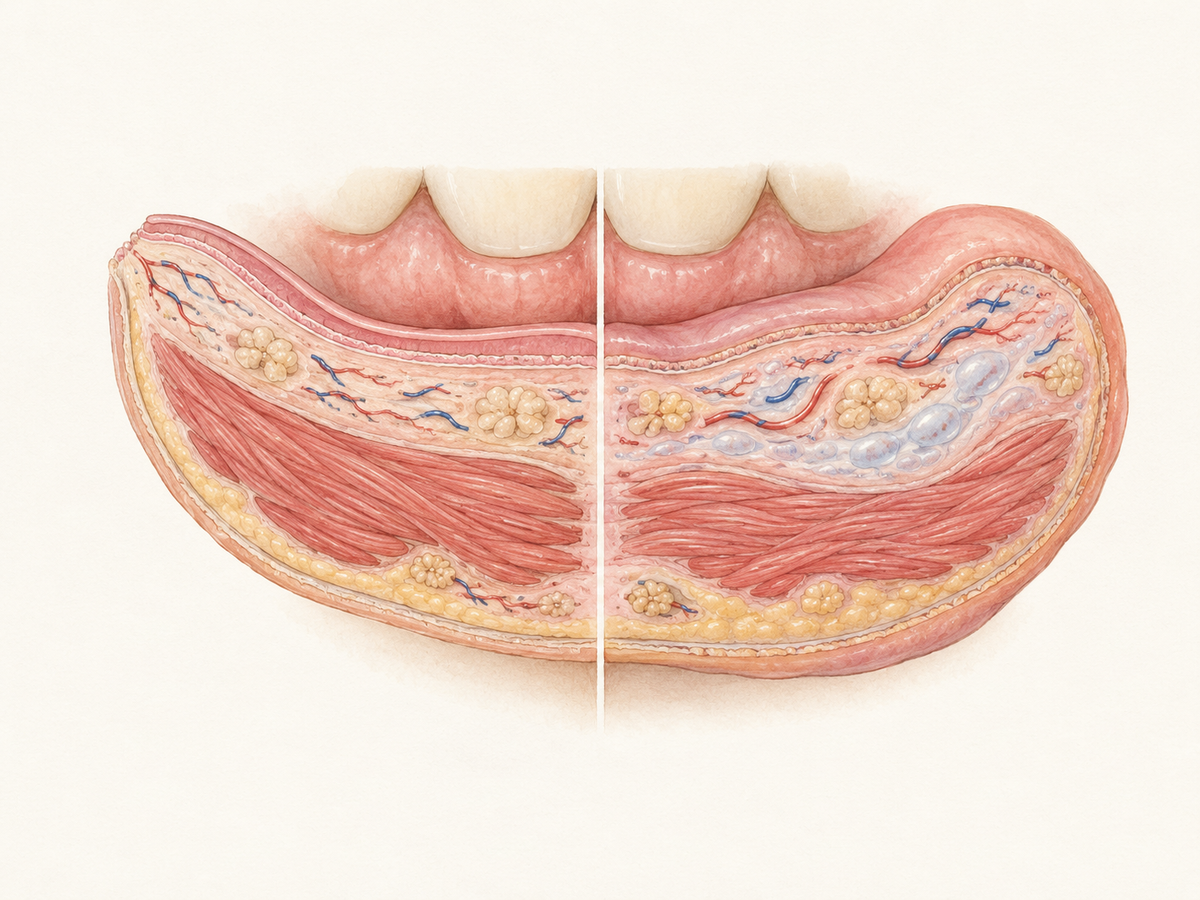








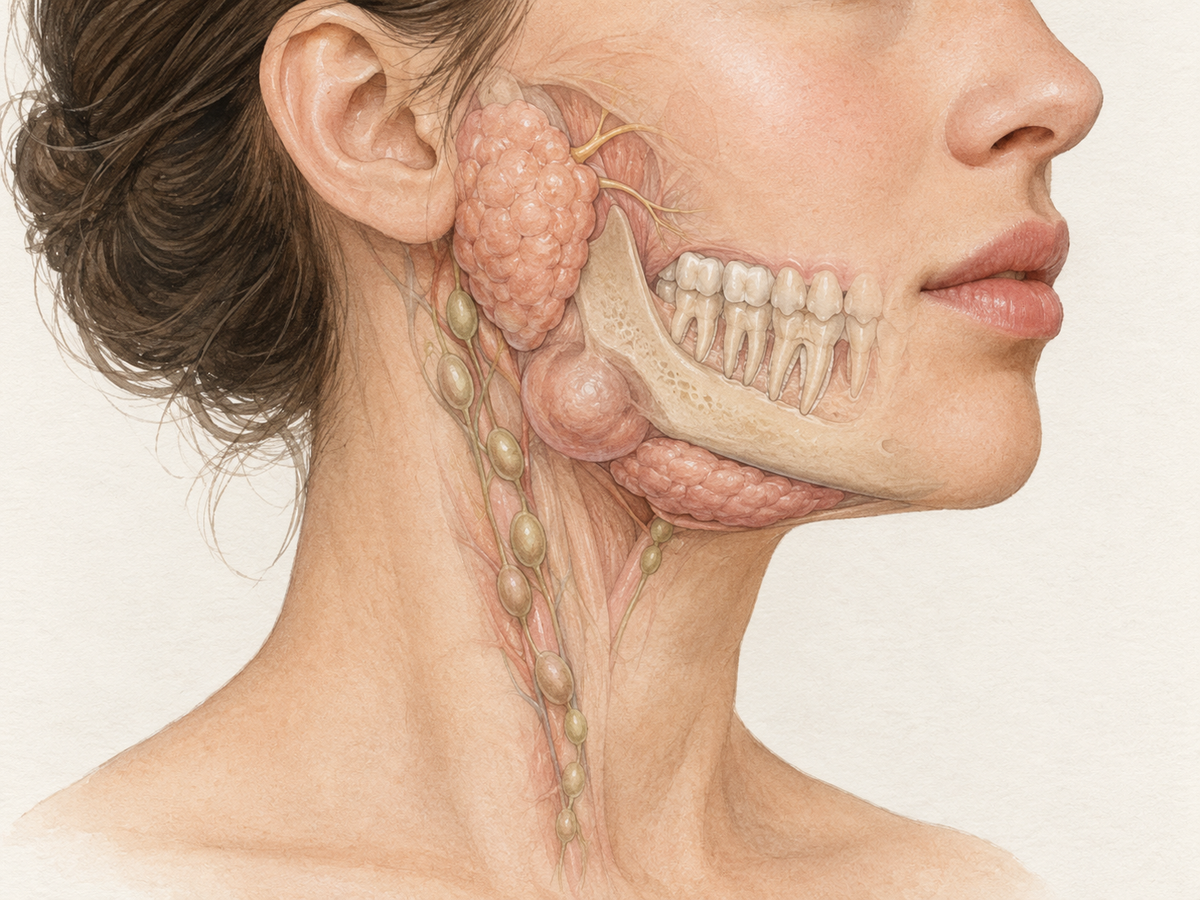
A lump along the jawline is most often a swollen lymph node or a swollen saliva gland. Many of these lumps are harmless and settle on their own when an infection or blockage clears. But a lump that lasts more than 2–3 weeks, grows, feels hard or fixed, or comes with fever, night sweats, weight loss, or trouble swallowing should be checked by a dentist or doctor.
A movable lump is not automatically harmless. Do not squeeze it, and pay attention to how it changes over 2–3 weeks.
Why Movability and Location Matter
A movable lump is one you can wiggle under the skin. A fixed lump feels attached to deeper tissue or the jawbone.
Movable lumps near the jawline often come from:
- Lymph nodes — small glands that help fight infection.
- Salivary glands — glands that make saliva.
- Superficial cysts — fluid-filled pockets under the skin.
A growth in the jawbone itself may feel hard or fixed. But movability alone does not rule out a serious cause. One neck mass guideline says features that raise concern include a lump that is attached to deeper tissue, feels firm, is larger than about 1.5 cm, or has an ulcer in the overlying skin, according to clinical guidance on neck masses.
Location helps organize the likely causes:
| Where the lump is | Common things to consider |
|---|---|
| Under the chin | Lymph nodes, submandibular or sublingual glands, a cyst |
| Along the jaw angle | Submandibular gland, lymph nodes, tooth-related swelling |
| In front of the ear | Parotid gland, preauricular lymph node |
| Inside the mouth or on the gum | Dental abscess, cyst, sore or irritated tissue |
These are clues, not a final answer.
Common Causes: Lymph Nodes and Infection
Swollen lymph nodes are by far the most common cause of lumps in the neck and jawline, according to an overview of cervical lymphadenopathy. They are part of the immune system. When you have an infection anywhere in the head or neck — a cold, a dental infection, gum disease, or a skin infection — the nearby nodes can swell while they work.
A reactive lymph node is often tender and movable, sometimes with a rubbery texture. None of those features alone confirms the cause, but they are common in nodes reacting to infection, according to guidance on lumps and swellings. The node may stay enlarged for a few weeks after the original infection fades.
This is often not a problem, but it should not be ignored. Pay attention if:
- A node is still enlarged after 2–3 weeks.
- It is growing or getting harder.
- You have lumps in several areas, like the armpit or groin.
- You also have fever, night sweats, or unexplained weight loss.
A guideline on neck masses suggests checking further when a lump has been present for two weeks or more without a clear infection, or when its duration is uncertain, according to evaluation guidance for adults.
Common Causes: Salivary Gland and Cyst Issues
The salivary glands near the jaw can swell when a duct is blocked, a small stone forms, or a cyst develops. This may feel like a smooth, movable lump near the jaw angle or under the chin.
One classic clue is meal-related swelling. The gland may ache or swell just before or during eating, then slowly settle. This pattern fits a blocked or inflamed saliva gland and can last hours to days, according to guidance on obstructive salivary gland conditions. Some people also have dry mouth or swelling that comes and goes.
A blocked duct or salivary stone is usually manageable. Ultrasound is often the first imaging test for the salivary glands, and it can help find stones or show whether a lump is from the gland or a nearby cyst, according to salivary gland imaging guidance. If needed, a dentist or ENT can order imaging or a minor procedure.
Common Causes: Dental and Jaw-Related Sources
Some lumps are tied to teeth, gums, or the jawbone. A dental abscess is an infection with pus around a tooth. It can cause pain, swelling, redness, warmth, fever, and sometimes a deep or fixed lump. Periodontal infection — infection in the gums and bone around teeth — can also create swelling.
Impacted wisdom teeth are teeth stuck under the gum. They can be linked to infection around the tooth, cysts, and damage to nearby teeth or bone, according to expert guidance on third molars. Some jaw cysts are connected to infected or dead teeth, and others form around unerupted teeth like wisdom teeth, according to a review of jaw cysts.
Dental causes deserve early attention because infection can spread. If you have tooth pain, gum swelling, fever, trouble opening your mouth, or recent dental work, start with a dentist. A tooth-related infection is usually checked with a dental X-ray or a wider panoramic image to see the source, according to a clinical guideline on dental infections.
Less Common But More Serious Possibilities
Less common causes include lymphoma, a salivary gland tumor, oral cancer, and rare bone tumors. These can sometimes feel movable or fixed. The point of this section is not to assume the worst, but to rule it out.
Features that should be checked sooner include:
- A lump that lasts, grows, or changes over several weeks.
- A hard or painless lump.
- A lump fixed to deeper tissue.
- Skin over the lump that breaks down or will not heal.
- A neck lump with no clear infection.
A clinical guideline says a neck mass is at higher risk when there is no infectious cause and the lump has lasted two weeks or more, or when it is firm, fixed, larger than about 1.5 cm, or has an ulcer in the overlying skin, according to neck mass evaluation guidance. If any of these fit, the next step is an exam and possibly imaging or a tissue sample. Most people with these signs will not have cancer, but the only way to be sure is to have a clinician look.
Red Flags: When to Seek Care Sooner
Some signs move the timeline from “mention later” to “call today.” They do not mean you have cancer. They mean the lump needs a faster look.
Call or book promptly if you have:
- Rapid growth over days to a few weeks.
- Fever, especially with swelling, redness, or difficulty opening the mouth.
- Night sweats.
- Unexplained weight loss.
- Trouble swallowing or breathing.
- Jaw stiffness or numbness in the lip, chin, or face.
- A hard or fixed lump.
- Skin changes over the lump, like an ulcer or sore that will not heal.
Referral guidance lists persistent unexplained neck lumps lasting more than three weeks and unexplained persistent swelling in the parotid or submandibular gland as reasons for suspected cancer referral, according to head and neck cancer detection guidance. Again, that does not mean cancer is likely. It means the lump should not be left to watch for longer.
If you have trouble breathing or swelling that feels like it is closing the throat, go to urgent or emergency care immediately.
Dentist or Doctor First?
Start with a dentist if:
- The lump is near a painful, broken, or recently treated tooth.
- You also have gum pain, gum swelling, or a bad taste.
- You have jaw pain or difficulty opening your mouth.
Start with a primary care clinician or an ear, nose, and throat specialist if:
- The lump is in the neck or under the jaw with no clear tooth or gum problem.
- You have salivary symptoms like meal-related swelling or dry mouth.
- The lump has lasted a few weeks without a clear cause.
Dentists can check teeth and jaws, take X-rays, and refer. Primary care clinicians and ENTs can assess lymph nodes, the throat, and salivary glands. Neck lump and salivary gland concerns are often referred to ENT or oral and maxillofacial surgery services, according to head and neck cancer service standards. If you choose the “wrong” starting point, don’t worry. Either can guide the next step.
What the Evaluation May Include
At the visit, the clinician will usually:
- Ask how long the lump has been there and whether it has changed.
- Ask about recent infections, dental work, fever, weight loss, or pain.
- Feel the lump and nearby lymph nodes.
- Look inside your mouth and throat.
- Check the skin over the lump.
Imaging depends on the suspected source. For a possible tooth or jaw problem, dental X-rays or a panoramic image can show the roots and surrounding bone, according to dental infection guidance. For salivary gland swelling, ultrasound is often the first test, according to salivary gland imaging guidance. For a neck mass that could be more serious, the clinician may order CT or MRI and a fine-needle aspiration. That is a thin needle used to sample a small amount of cells from the lump, according to neck mass evaluation guidance. A biopsy may be recommended if the lump looks suspicious.
The clinician is checking the lump’s size, texture, mobility, tenderness, borders, and nearby tissue. These details help decide between watching and sending you for imaging, biopsy, or a specialist visit.
What You Can Do While Waiting
While you wait for an appointment:
- Record the lump’s size and date. A photo or a ruler held next to it can help.
- Note any new symptoms, such as pain, fever, or swallowing changes.
- Keep your mouth clean with gentle brushing and flossing if it is not painful.
- Do not squeeze, poke, or press the lump.
- Do not put heat on it.
- Do not start antibiotics without a clinician. Antibiotics only help certain bacterial infections, and using the wrong one can delay the right diagnosis, according to neck mass guidance.
Remember: a movable lump is not automatically harmless. Squeezing it can worsen infection or inflammation. If the lump persists, grows, or changes, book an appointment. That is the simplest and safest next move.
This article has been reviewed by an oral health professional for accuracy. It is intended to provide general educational information and should not be used as a substitute for personalized medical advice, diagnosis, or treatment. If you have questions or concerns about your oral health, please consult a dentist, physician, or other qualified healthcare provider.