












Periodontal disease is an infection and inflammation of the gums and the tissues that hold teeth in place. It often starts as gingivitis, which can be reversed, but it can progress to periodontitis, which causes permanent damage to the bone and ligaments around teeth. Bleeding gums during brushing or flossing are an early warning sign. Catching the condition early gives you the best chance to stop the damage.
Bleeding gums are not normal. Treat regular gum bleeding as a signal to schedule a dental visit.
How Gum Disease Begins
Your teeth are covered by a sticky film called plaque. It is made up of bacteria that attach to the tooth surface and form a biofilm, a kind of organized bacterial community. When plaque sits at the gumline, your immune system responds. That response causes gum inflammation, which can make the gums red, swollen, and more likely to bleed.
Plaque can be removed with daily brushing and cleaning between the teeth. But if plaque remains, minerals from saliva can harden it into tartar, also called calculus. Tartar is rough and firmly attached. You cannot brush or floss it away. It keeps bacteria against the gums and gives them a place to grow.
Tartar itself is not the main irritant. It is usually covered with living bacterial biofilm. So it acts as a shelter that keeps the infection and inflammation going. This is why gum disease is more than just bleeding gums. It is a bacterial infection and an inflammatory condition, according to research on plaque biofilms and gum inflammation.
Gingivitis vs. Periodontitis
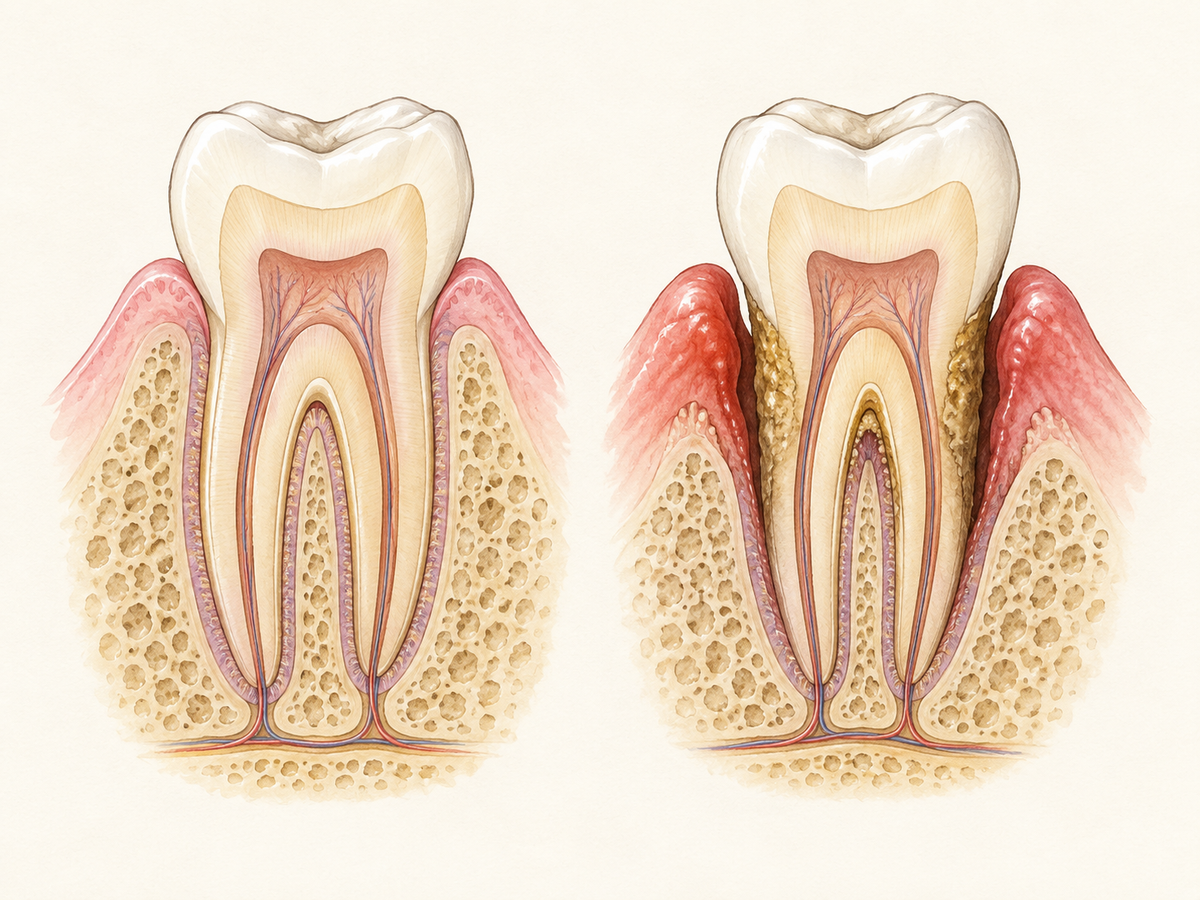
Gingivitis is the early stage. It affects only the gums. The gums may bleed, look red, and feel tender, but the bone and fibers that hold teeth are still intact. With good daily care and a professional cleaning, gingivitis can be reversed.
Periodontitis is the advanced stage. The inflammation moves below the gumline and starts destroying the tooth-supporting ligament and the jawbone. This damage is not reversible. A key change is the formation of gum pockets, or spaces between the gum and tooth where bacteria collect. As the pockets deepen, the bone around the tooth shrinks away.
A dentist tells these stages apart by measuring pocket depths and checking for bone loss on x-rays. Early treatment matters because gingivitis can be reversed, while periodontitis can only be managed to stop further harm. According to clinical guidance on gum disease classification, the transition to periodontitis results in attachment loss that is currently irreversible.
Symptoms That Show Up Early—and Late
| Early signs | Advanced signs |
|---|---|
| Gums that bleed when you brush or floss | Gums that pull back or recede |
| Red, swollen, or tender gums | Teeth that feel loose or shift |
| Bad breath that keeps coming back | Pain when chewing |
| A bite that feels different |
The tricky part is that periodontal disease can be painless. You may not feel anything until the damage is already significant. That is why bleeding gums and other early signs matter, even if they do not hurt. People with gum disease can have mild symptoms or none at all, which is why regular dental checks are important for catching it, according to a global public health review.
Who’s More Likely to Get It
Some factors make gum disease more likely because they help plaque build up or make the gums more sensitive.
- Poor oral hygiene: Plaque that stays on teeth can cause inflammation.
- Smoking or tobacco use: Smoking is one of the strongest known risk factors.
- Diabetes: Blood sugar that is not well controlled can make gums more vulnerable and may worsen gum disease.
- Family history or genes: Some people are more likely to develop severe gum disease because of their genetic makeup.
- Hormonal changes: Pregnancy and other hormone shifts can make gums more sensitive.
- Medications: Some medicines can reduce saliva or affect gum tissue, which may make plaque harder to manage.
- Older age: Gum disease becomes more common with age, partly because damage builds up over time.
Smoking and diabetes are among the most consistent risk factors in research on periodontitis risk, and smoking is also highlighted in regional reviews. Genetic differences may also play a role in how strongly the body reacts to plaque, according to a systematic review of genetic studies.
Risk factors can combine. That is not about blame. It is about knowing when extra care may help.
Why It Matters Beyond Your Mouth
The most direct consequences happen in the mouth. Advanced periodontitis can destroy the bone that supports the teeth. Teeth can become loose and eventually fall out. Even before that, an unstable bite or sore gums can make eating harder. This is a major reason periodontitis is taken seriously in clinical guidance on periodontal disease.
Researchers have also looked at links between gum disease and heart disease, diabetes, and pregnancy complications. These are associations, not proof that gum disease directly causes those conditions. Many people with gum disease also have other risk factors such as smoking, diabetes, or age, which can make the relationships harder to interpret. Reviews that grade the evidence have classified much of it as low to very low certainty, according to an umbrella review of oral-systemic associations.
That does not mean gum health is unimportant for the rest of the body. It does mean gum disease should be treated for the damage it does in the mouth, while medical conditions should be managed with a doctor.
Preventing It at Home
Home care is where prevention starts. The goal is to remove plaque before it hardens into tartar.
- Brush twice a day with fluoride toothpaste.
- Clean between your teeth every day with floss, interdental brushes, or another tool that fits.
- Brush gently along the gumline, not just the tops of the teeth.
- Do not smoke. If you smoke, quitting is one of the best things you can do for your gums.
- Aim for consistency. Doing these steps every day matters more than perfect technique.
Home care supports gum health, but it cannot remove tartar by itself. Once plaque has hardened, a dental professional needs to remove it. That is why regular cleanings and checkups are part of prevention, not an optional extra, according to step-by-step treatment guidance.
Professional Treatment Options
If gum disease has already developed, treatment usually starts with the least invasive option.
- Scaling and root planing, often called a deep cleaning, removes plaque and tartar above and below the gumline and smooths the tooth root.
- Antibiotics may be used in some cases to help control bacteria.
- Laser therapy may be offered as an additional tool, but it is not a replacement for removing plaque and tartar.
When pockets are deep or bone loss is severe, surgery may be considered. Options include flap surgery, which lifts the gums to clean the roots; grafts to replace gum or bone tissue; and bone regeneration procedures. These treatments aim to stop the disease and preserve teeth. They cannot guarantee that lost bone will grow back. This is consistent with reviews of nonsurgical and surgical treatment.
When to See a Dentist
See a dentist if you notice any of these:
- Gums that bleed when you brush or floss
- Bad breath that does not go away
- Gums that are pulling away from your teeth
- Teeth that feel loose or are shifting
- Pain when chewing or touching a tooth or gum
- You smoke, have diabetes, or have a family history of gum disease
Do not wait for pain. Pain often appears late, after damage has already occurred. A dentist can measure gum pockets and check for bone loss on x-rays. That exam helps tell the difference between reversible gingivitis and periodontitis that needs ongoing management, based on guidance for detecting gum disease.
This article has been reviewed by an oral health professional for accuracy. It is intended to provide general educational information and should not be used as a substitute for personalized medical advice, diagnosis, or treatment. If you have questions or concerns about your oral health, please consult a dentist, physician, or other qualified healthcare provider.