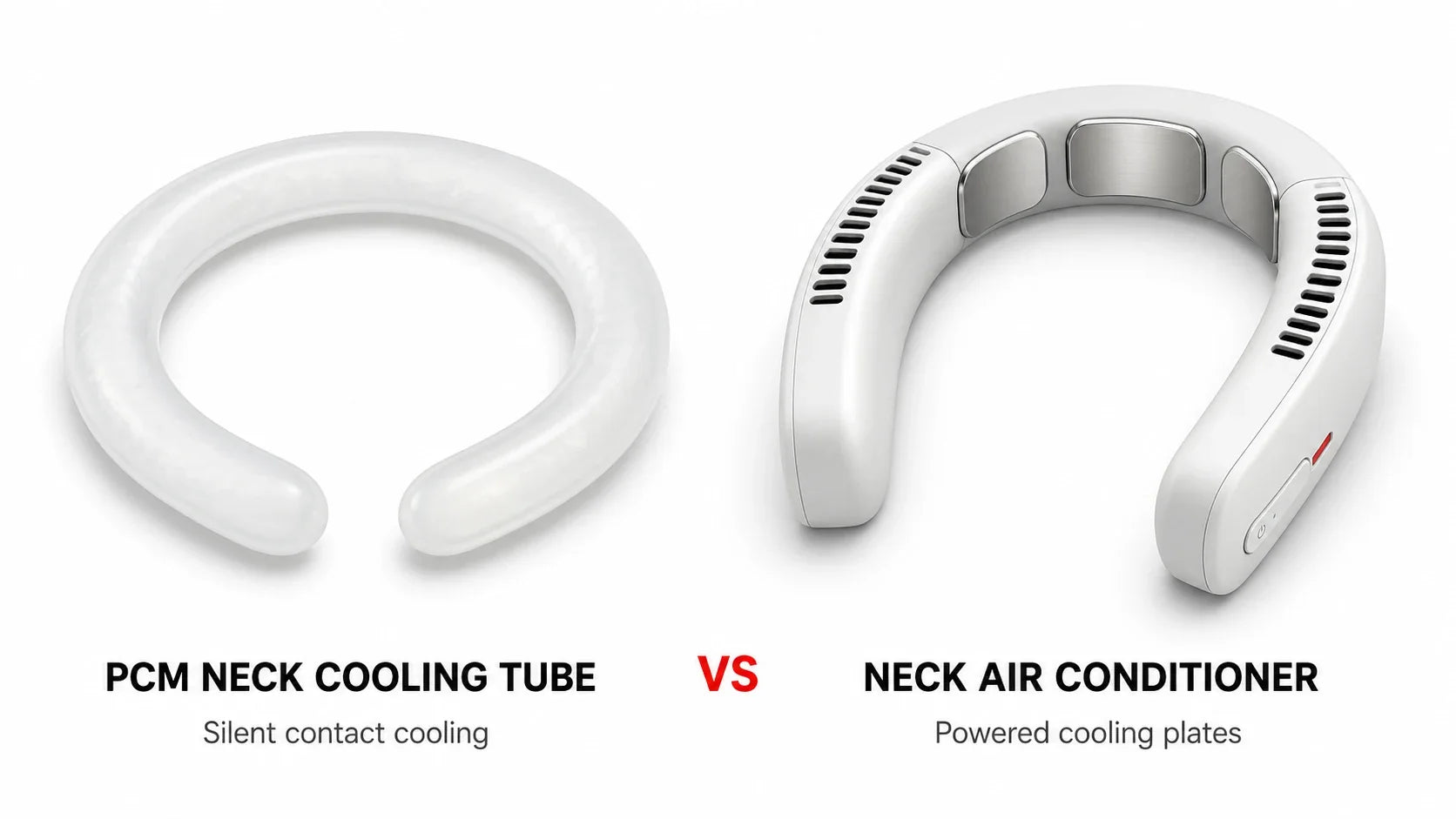





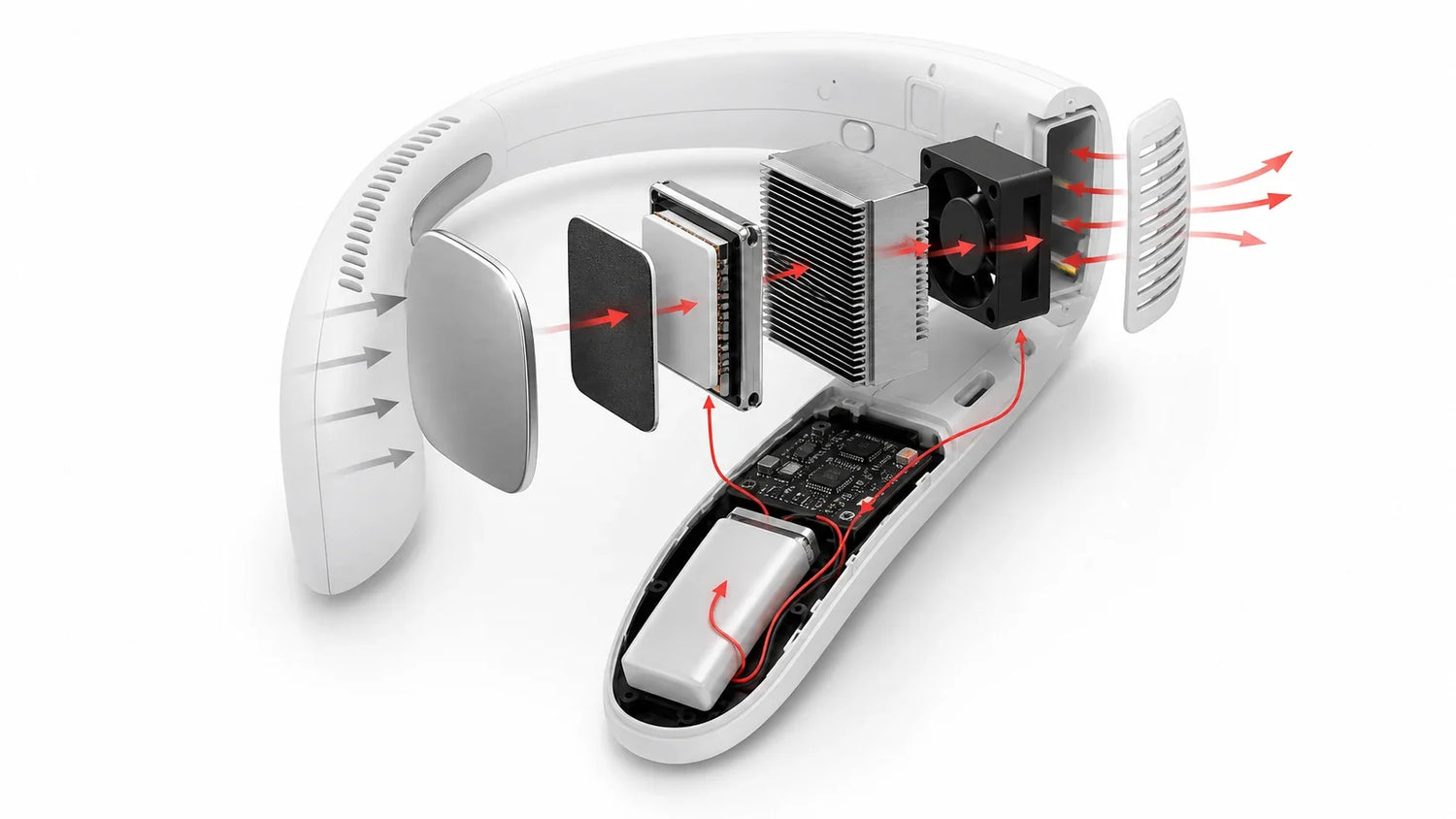
The short answer: A Peltier cooler is most efficient at a modest temperature difference because extra current also creates heat.
A colder plate sounds better.
It is not the whole story.
More power can create stronger cooling at first. It also creates more heat. The battery drains faster, and the hot side has more work to do.
Good design balances four things:
-
cooling power;
-
temperature difference;
-
heat rejection; and
-
electrical power.
This guide turns those engineering terms into useful buying questions.
What does Peltier cooler efficiency mean?
Engineers often use coefficient of performance, or COP.
For cooling:
COP = heat removed from the cold side ÷ electrical input power
The heat removed is called Qc. Electrical input is called Pin.
If a module removes 4 watts of heat while using 8 watts of electricity:
COP = 4 ÷ 8 = 0.5

That does not mean the plate is “50% cold.”
It means the system moves 0.5 watt of heat for every watt of electrical input under that test condition.
Ferrotec defines thermoelectric cooling COP as Qc ÷ Pin in its module model.[1]
If you need the basic heat-pumping explanation first, read how a Peltier cooler works.
Module efficiency is not system efficiency
A Peltier module is only one part of a wearable cooler.
The complete system may also use:
-
heat-side fans;
-
air-moving comfort fans;
-
voltage converters;
-
sensors;
-
control electronics; and
-
battery protection circuits.
Module COP only compares the heat pumped by the Peltier element with its own electrical input.
System COP should include the power used by the supporting hardware.
Skin comfort is different again.
A cool metal plate can feel effective over a small area. That feeling does not prove high COP. It also does not mean the device cools the whole body or room.
Keep these three measures separate:
| Measure | What it answers |
|---|---|
| Module COP | How efficiently the TEC pumps heat at one operating point |
| System efficiency | How much cooling the complete product delivers for total power |
| User comfort | How the contact area, airflow, fit and controls feel in use |
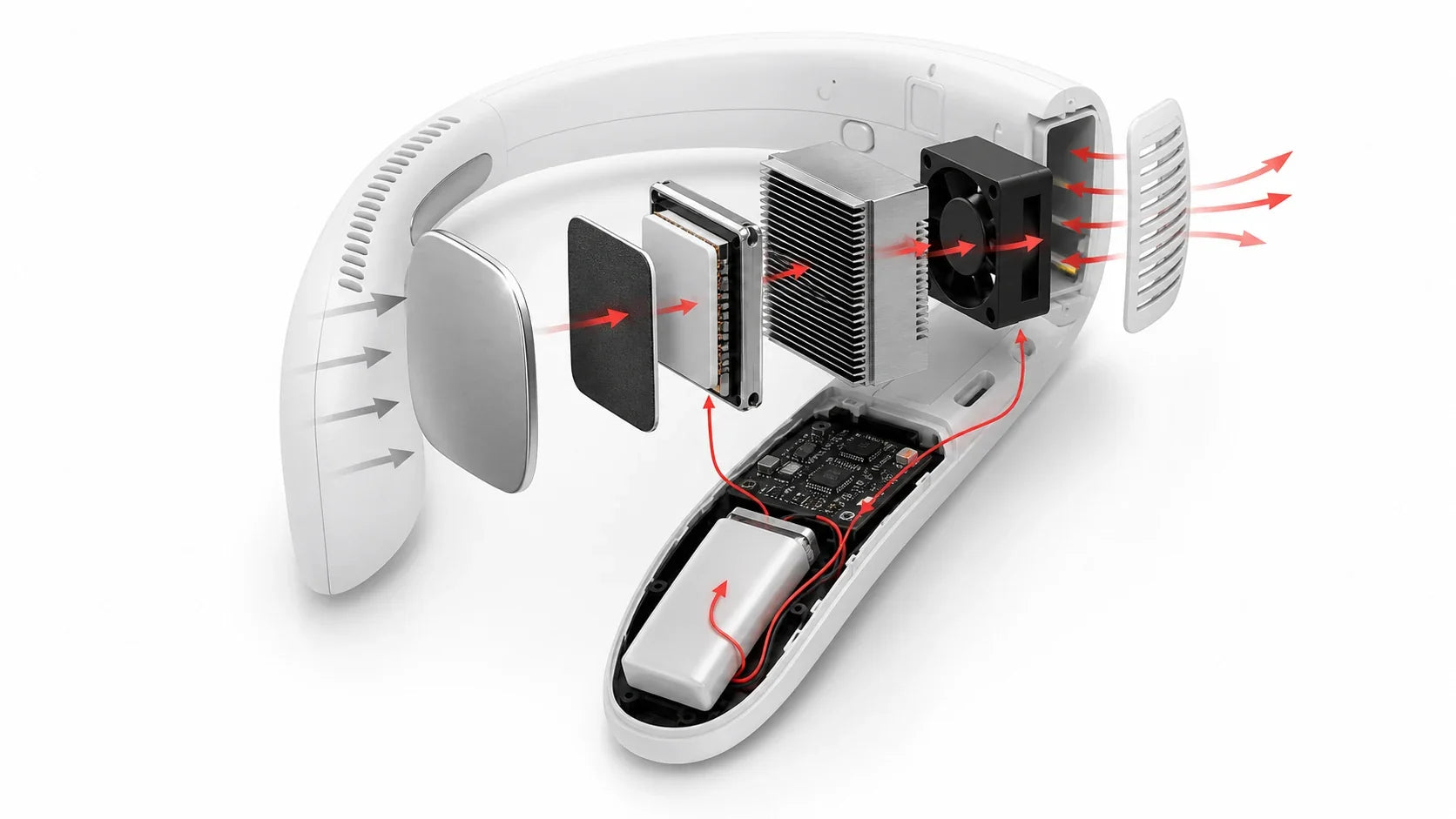
The hot side must reject more heat than the cold side absorbs
A Peltier cooler does not destroy heat.
It moves heat from the cold side to the hot side.
The hot side must reject two inputs:
Hot-side heat (Qh) = cold-side heat (Qc) + electrical power (Pin)
Use the earlier example.
The module removes 4 watts from the cold side. It consumes 8 watts of electricity.
The hot side must release:
4 W + 8 W = 12 W
This is why the heat sink matters so much.
Ferrotec states that the heat sink must dissipate both the pumped heat and the Joule heat created by electrical input.[2]
If hot-side heat cannot escape, the hot-side temperature rises. The cold side then has to work across a harder temperature gap.
Cooling performance falls.
Why a larger temperature difference lowers COP
Temperature difference is written as ΔT.
For a cooler:
ΔT = hot-side temperature − cold-side temperature
A larger ΔT sounds impressive. It is also harder to maintain.
Three effects act inside a Peltier element:
-
The Peltier effect pumps heat toward the hot side.
-
Electrical resistance creates Joule heat.
-
Heat conducts back from the hot side toward the cold side.
As ΔT grows, thermal backflow grows. The module has less net capacity left for the real cooling load.
Ferrotec’s design guide notes that heat-pumping capacity is highest when ΔT is near zero and falls as the desired temperature difference increases.[3]
That creates an important warning about specifications.
Maximum ΔT is normally an unloaded limit.
It is measured when almost no useful heat enters the cold side. Ferrotec defines ΔTmax at effectively zero cold-side heat load.[4]
Human skin is not a zero-load condition.
Skin continuously supplies heat to the plate. Warm air, poor contact and heat leaking through the housing add more load.
So an unloaded module number is not a realistic on-neck temperature promise.
Why adding current eventually stops helping

Peltier cooling does not rise in a straight line with current.
The useful Peltier pumping term grows roughly with current.
Resistive heating grows with current squared.
Double the current, and the resistive-heating term can rise by about four times if resistance stays similar.
At low current, adding power may increase useful cooling.
At higher current, Joule heating catches up. The hot side becomes harder to cool. COP falls, and battery demand rises quickly.
Controlled experiments on single-stage TECs have found that COP decreases as current increases, even when a larger current can increase temperature difference under some conditions.[5]
This is why one Peltier element has different operating points:
-
maximum efficiency;
-
maximum cooling capacity; and
-
maximum temperature difference.
They are not the same point.
For a wearable product, maximum mode may deliver a strong first sensation. A moderate mode may provide better sustained comfort per watt.
Thermal resistance decides how hot the hot side becomes
Heat-sink performance is often expressed as thermal resistance.
The common unit is degrees Celsius per watt, written °C/W.
Use this simplified relationship:
Hot-side rise above ambient = heat-sink thermal resistance × hot-side heat
Assume the hot side must reject 12 watts.
With a 2°C/W thermal path, the estimated rise is:
12 W × 2°C/W = 24°C
With a 0.8°C/W path:
12 W × 0.8°C/W = 9.6°C
These are hypothetical examples. Real products also have contact resistance, changing airflow and warm exhaust recirculation.
The lesson is simple.
Lower thermal resistance keeps the hot side closer to ambient. That gives the cold side more room to work.
The Ferrotec heat-sink guide uses the same temperature-rise divided by heat-flow definition.[2]
Why wearable heat sinks are difficult
A laboratory heat sink can be large and heavy.
A neck-worn product cannot.
Designers must balance:
| Design choice | Potential gain | Likely cost |
|---|---|---|
| Larger heat sink | Lower hot-side temperature | More size and weight |
| Faster exhaust fan | Better heat rejection | More noise and battery use |
| Larger battery | Longer runtime | More weight |
| Larger cooling plate | More contact area | More heat load and fit constraints |
| Higher current | Stronger initial cooling | Lower COP, more heat and shorter runtime |
| Lower-power control | Better efficiency | Less aggressive cold sensation |
Wearable-TEC research continues to focus on heat sinks, heat spreading and skin interfaces because hot-side heat rejection limits sustained cooling.[6][7]
This is the central wearable tradeoff:
Cooling, runtime, weight and noise cannot all be maximized at once.
What hot-side airflow changes in real use
The heat sink needs cool incoming air and a clear exhaust path.
Long hair, a high collar or a backpack strap can block that path.
Warm exhaust can also loop back into an intake. Engineers call this recirculation.
The product may still turn on. The plate may still feel cool for a short time.
But the hot side warms faster. Sustained cooling weakens.
When comparing products, look beyond the number of vents.
Ask:
-
Where does air enter?
-
Where does hot air leave?
-
Can clothing cover either path?
-
Does exhaust blow back onto the skin?
-
Does the device reduce power when the hot side overheats?
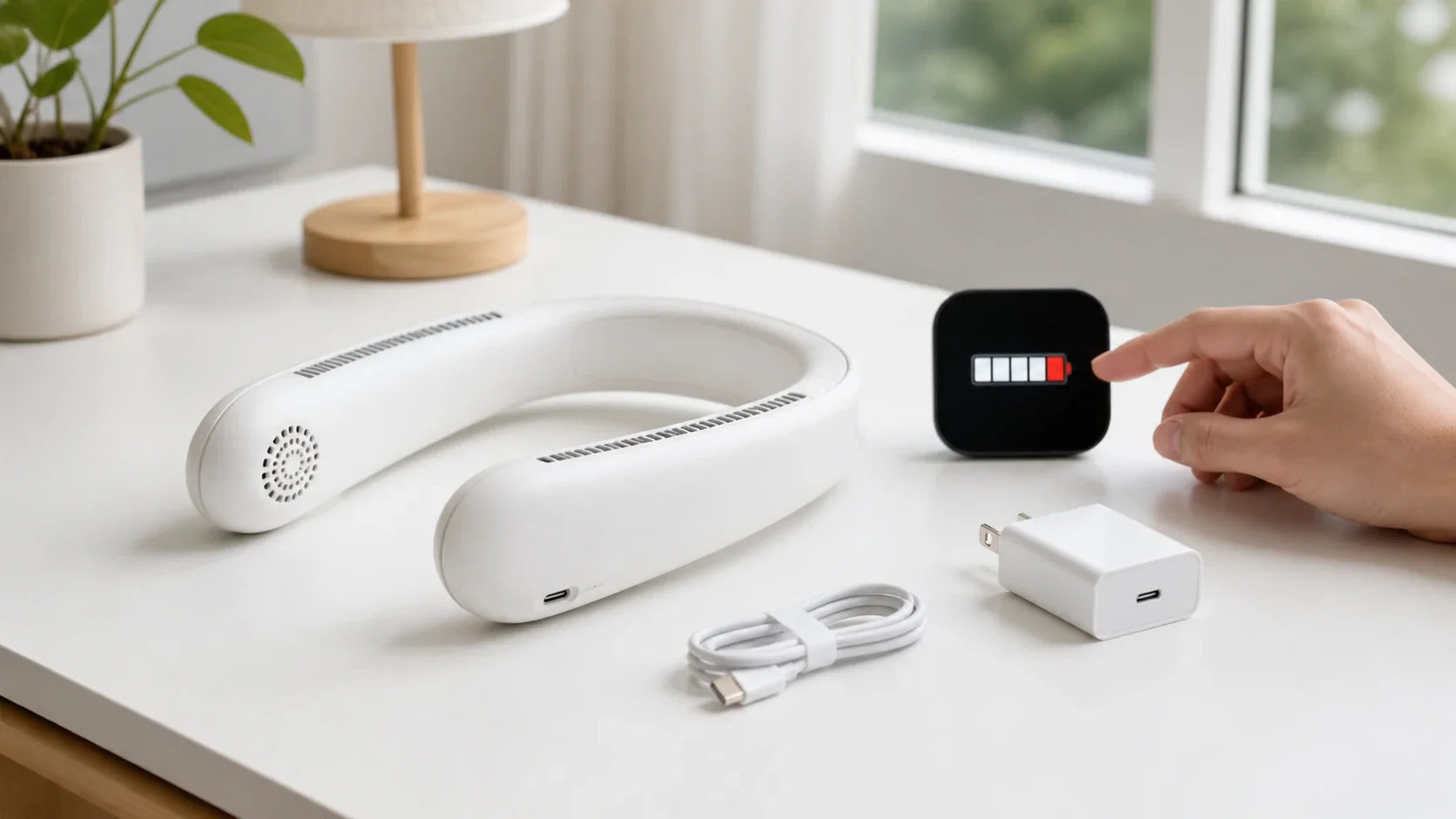
How battery life changes with Peltier efficiency
Lower COP means more electrical energy is needed for the same useful heat removal.
That energy comes from the battery.
If a stronger mode doubles system power, runtime may approach half under otherwise similar conditions. Real controllers, conversion losses and battery protection make the exact relationship less tidy.
Do not compare battery capacity alone.
Compare watt-hours, mode-specific power and measured runtime. Our neck fan battery life guide includes a simple runtime estimator.
Also check whether the published runtime uses:
-
fan-only mode;
-
active cooling;
-
the lowest setting; or
-
a mixed automatic mode.
A single “up to” number can hide a large difference.
How to read a Peltier cooling claim

Temperature claims need a test condition.
Before trusting a number, ask six questions.
1. What temperature was measured?
Was it the bare cooling plate, the skin surface, the exhaust or the surrounding air?
These are not interchangeable.
2. What was the reference temperature?
“20 degrees cooler” could mean below ambient air, below the hot side or below the plate’s starting temperature.
The reference must be named.
3. Was there a real heat load?
An unloaded plate can reach a lower temperature than a plate touching warm skin.
Look for loaded or on-body data.
4. How long did the test run?
A startup minimum may last only briefly.
Sustained temperature after thermal stabilization is more useful.
5. What was the ambient condition?
Record air temperature, humidity and airflow.
Hot-side performance changes with the environment.
6. What power and mode were used?
A temperature result without watts, mode and battery impact is incomplete.
For a broader comparison of airflow, contact cooling and evaporation, see fans that blow cold air like AC.
A practical Peltier efficiency test
You do not need a full laboratory to create more useful evidence.
You do need a controlled method.
Measure these values
-
ambient temperature and humidity;
-
hot-side temperature;
-
plate temperature;
-
electrical voltage and current;
-
total system power;
-
battery runtime;
-
fan mode; and
-
applied cold-side heat load.
Run three comparisons
First, test one current level with strong hot-side airflow and restricted airflow.
Second, test low, medium and high power with the same heat sink condition.
Third, repeat at more than one cold-side load.
Wait for temperatures to stabilize. Repeat each condition.
Plot:
-
cooling capacity versus current;
-
COP versus current;
-
cold-side temperature versus time; and
-
hot-side temperature versus time.
Do not combine module power and complete-system power without labeling them.
Frequently asked questions
Are Peltier coolers energy efficient?
They can be useful for compact, local and precisely controlled cooling, but COP depends strongly on current, temperature difference, heat load and heat-sink performance.
Why does adding power stop helping?
Useful Peltier pumping rises with current, while resistive heating rises roughly with current squared and increases the hot-side burden.
What is a realistic Peltier temperature drop?
There is no universal number. Use loaded, steady-state data from the complete product under stated ambient conditions.
Why does the cooling plate become warmer after startup?
The hot side may be warming, the load may be increasing or the controller may be reducing power. Skin adaptation can also make the plate feel less cold.
Does a larger Peltier element always cool better?
No. It also needs adequate power, plate contact and hot-side heat rejection.
Is a Peltier cooler more efficient than a compressor?
That depends on scale and use. Peltier systems favor compact, solid-state local control; compressors usually serve larger cooling loads more efficiently. Our upcoming thermoelectric-versus-compressor guide will explain the difference.
The bottom line
Peltier efficiency is a system problem.
Do not judge it by plate temperature alone.
Check COP, power, hot-side temperature, test load and steady-state performance together.
A well-designed wearable does not chase the lowest possible plate temperature at any cost. It balances sustained comfort, heat rejection, noise, weight and battery life.
Next step: Compare the Peltier operating point with the device’s mode-specific runtime and hot-side temperature data.