



Rubber bands, or orthodontic elastics, are used with braces because braces alone mainly straighten teeth, but they often cannot fix how the upper and lower teeth meet. The bands apply a steady, light pull that moves the upper and lower teeth into a better bite. They only do that job well when they are worn exactly as your orthodontist directs, usually most of the day and night.
Before you leave the office, ask your orthodontist to show you exactly where the bands hook, how long to wear them each day, and how often to replace them.
How Elastics Actually Move Teeth
Braces use brackets and a main wire to line up teeth within each arch. That is great for straightening teeth, but the upper and lower teeth still need to meet in the right way.
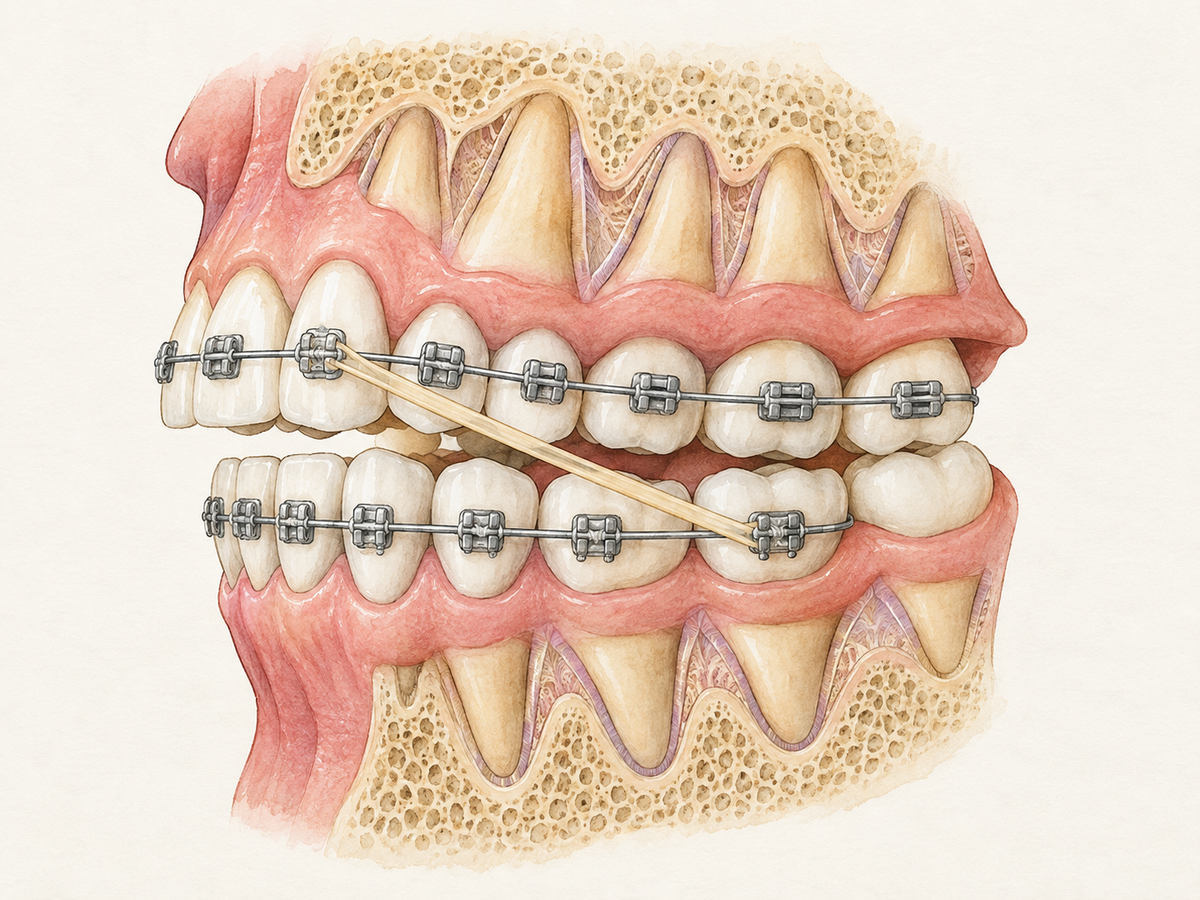
Elastics connect the top and bottom braces, creating a gentle, continuous force that guides the bite into position. Think of braces as scaffolding and elastics as guide wires. The scaffolding holds things in place while the guide wires pull top and bottom into better alignment.
Teeth move when steady pressure is kept on them, not from occasional hard pulling. That is why light, continuous force is preferred. A review of orthodontic elastics explains that light continuous forces are safer and more efficient for steady tooth movement.
Elastics do not make the jaw grow. They shift teeth gradually within the supporting bone, which is why the change depends on consistent wear.
What Bite Problems They Correct
Your elastic pattern is chosen for your specific bite problem. The direction the band pulls tells the teeth where to go.
One common pattern, called a Class II elastic, connects the upper front area to the lower back teeth. It is often used when the lower teeth sit too far back compared with the upper teeth. The opposite pattern can be used when the lower teeth sit too far forward. The direction of the elastic hookup is what determines which way teeth move, according to a biomechanics review of intermaxillary elastics.
| Bite issue | What it means | Elastic goal |
|---|---|---|
| Overbite, or deep bite | Upper front teeth cover too much of the lower front teeth. | Help reduce the excessive overlap and settle the bite. |
| Underbite | Lower front teeth sit ahead of upper front teeth. | Help bring the lower teeth back and upper teeth forward. |
| Crossbite | Some upper teeth bite inside the lower teeth. | Help guide teeth into a more normal side-to-side position. |
| Open bite | Front or back teeth do not touch when you bite. | Help close the space and improve contact. |
| Midline shift | The center line of upper and lower teeth does not match. | Help guide the bite toward a more balanced center. |
| Gaps or spaces | Extra space remains between teeth. | Help close or reduce spaces while the bite is corrected. |
This is why your friend’s band pattern may look different from yours. It is not a one-size-fits-all step.
Why Your Elastic Plan Is Custom
Your orthodontist chooses the band size, strength, wear time, and hook placement based on your bite diagnosis, the stage of treatment, and how much support is needed. That support is sometimes called anchorage, which means keeping certain teeth from moving too much while other teeth are shifting.
Your plan may include:
- Band size: The diameter of the band affects how it fits and how it pulls.
- Strength: Lighter bands may be used for settling and finishing. Medium bands may be used when more bite correction is needed.
- Hook placement: Where the band attaches controls the direction of tooth movement.
- Wear schedule: Many plans call for around 20 to 22 hours of wear per day, but some people wear bands only at certain stages.
A review of orthodontic elastics notes that lighter forces are often preferred for vertical control and finishing, while medium forces are commonly used for bite correction.
Two people can both have braces and still have completely different elastic routines. That is normal. It just means your orthodontist is matching the plan to your mouth, not using the same protocol for everyone.
What They Improve Long-Term
Elastics are about finishing the bite, not just making teeth look straight. When the upper and lower teeth fit together properly, chewing becomes more even, and you are less likely to put repeated stress on a few teeth. A balanced bite may also reduce uneven wear on enamel over time.
Elastics can help correct the way the upper and lower teeth meet, according to a systematic review of Class II correction. Once the bite is corrected, retainers do the main work of holding teeth in place. Elastics are not a substitute for retention.
The short-term hassle of wearing bands protects the larger investment you have already made in braces. That is why the daily routine is worth it.
What Happens If You Don’t Wear Them
Wearing the bands as instructed is the main factor that determines whether they work. Inconsistent use is strongly linked to treatment delay, according to clinical guidance on orthodontic elastics.
If bands are worn only part of the time:
- The bite correction can stall.
- Treatment may take longer than planned.
- Your orthodontist may need to adjust the plan or add more time.
- The final result may settle less predictably.
- Your orthodontist can often tell that progress is not matching the schedule.
This is not meant to scare you. It is more like cause and effect. The bands only move teeth when they are actually in place.
If you forget a full day, do not double up the bands to catch up. Return to your normal schedule and mention it at your next visit.
Comfort, Care, and Daily Wear
Some soreness is normal when you start or change bands. The tenderness usually peaks around 12 hours after new force is applied and often improves within a few days, according to guidance on managing orthodontic pain.
Simple ways to manage the first day or two:
- Eat soft foods if chewing feels tender.
- Use orthodontic wax if hooks or bands rub your cheeks.
- Take an over-the-counter pain reliever if needed and if your doctor or dentist says it is okay.
- Replace bands as directed, often once or twice a day.
- Keep spare bands in your bag.
Some orthodontists tell you to remove bands for meals and brushing. Others may ask you to keep them in while eating. Follow your plan. If you do remove them, put them right back in afterward.
If a band breaks or you run out:
- Replace it with a fresh band as soon as you can.
- Do not double a broken band or use a regular office rubber band.
- If you are out, call your orthodontist for more.
- If pain is severe or a hook feels broken, contact the office rather than guessing.
Questions to Ask Your Orthodontist
At your next adjustment, ask:
- What exactly is my elastic pattern correcting?
- How many hours per day should I wear the bands?
- How often should I change them?
- What should I do if I miss a day?
- How should I handle meals and brushing?
- What should I do if I run out or a band breaks?
- When should I expect to see changes?
Rubber bands only work when they are in your mouth. If the plan is unclear, ask before guessing. Wearing them consistently, replacing them as directed, and checking in with your orthodontist gives you the best chance of finishing with a bite that feels good and holds up over time.
 Best Overall
 Best Value
 Best for Sensitive Teeth
This article has been reviewed by an oral health professional for accuracy. It is intended to provide general educational information and should not be used as a substitute for personalized medical advice, diagnosis, or treatment. If you have questions or concerns about your oral health, please consult a dentist, physician, or other qualified healthcare provider.